Compressed Air System Improvements in the Cement Industry
Article Source: The following article is an excerpt from Compressed Air Best Practices® Magazine, originally published in June 2026. We are pleased to share this industry insight on our blog and acknowledge the original publication as the source of this content.
Written by: Bhaskar Dusi, Manager Process Fuels & Energy, CalPortland
In the cement industry, compressed air is a flexible yet inefficient energy source, with 8-12% conversion efficiency at best. Its flexibility often leads to misuse, which can significantly increase costs. Poor design and maintenance can make compressed air systems a major area of energy waste.
In past years, when plants were built, individual air compressors were installed in departments throughout the plant with no or little storage. There was no compressed air system piping linking the air compressors and no central control systems. To learn the operating pressure and other operating information, one needed to go to the air compressor and note the information. Each air compressor operated as an island and supplied air to one location. This necessitated the need for many air compressors within efficient operation, as extra capacity from any air compressor couldn’t be shared with other locations. Most of the compressed air piping was underground, making leak detection and rectification difficult.
Conducting detailed compressed air assessments was rare due to low power cost and a lack of sophisticated instrumentation for measuring pressure, flow and leak detection. With the advent of new technology, nowadays we perform compressed air assessments to evaluate the operational issues facing the plant. The goal of these assessments is to get specific recommendations addressing the cost of operation, air quality, repeatability, reliability issues, maintenance and potential productivity improvements.
The most important issues are how the compressed air is made and used. Assessments help operators and maintenance personnel understand the cost per scfm and the air consumption of various processes in the facility. The focus should be on maintaining compressed air as a controllable expense and promoting interdepartmental cooperation.
Demand-side assessments are important, as lowered demand enhances plant productivity by easing the burden on clean-up equipment, improving system stability and pressure flexibility and increasing redundancy as air compressors are turned off. Additionally, reducing compressed air consumption helps avoid capital expenses by extending
the life of air compressors.
One of the most common problems in cement plants is low air pressure. Improved control strategies and waste reduction can resolve this issue. In one plant, we reduced the overall output requirements of the air compressors by over 800 scfm, which saved considerable money. Long-term optimization strategies include continuous monitoring of compressed air systems and upgrading control systems. Some of the best practices we implement include reducing compressed air operating pressure and providing the appropriate amount of compressed air storage for load-unload control. All dust collectors use differential pressure pulse-jet control with a pulse jet management system. Air slides use low-pressure blower-produced air instead of compressed air.
Cement kiln shell cooling is accomplished with high-volume flow fans rather than compressed air nozzles. We installed a VSD air compressor with multi-air compressor controllers to improve compression efficiency and automatic reserve capacity. We also use hurricane air canons, which use 50% less air.
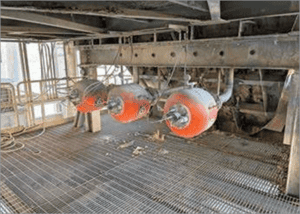
This older kiln blow-off system, which used 100 scfm of compressed air, was replaced with a new kiln blow-off system that included air cannons using 30 scfm of compressed air.
In the coming years, we expect more plants to opt for centralized compressed air stations with central control and monitoring systems. Plants will also put appropriate storage tanks at each demand department to operate air compressors at full load for maximum efficiency with one or two modulating air compressors.
Contact Us
For more information about our Cement, Ready-Mixed Concrete, Aggregates, Asphalt, or Construction Services, please complete the form below and a member of our team will respond promptly.
Prefer to speak with someone directly? Call us at: